Practice times are in one person's calendar. The shopping list is on the fridge. The note about gym clothes came by text yesterday and is buried up the thread by now. Nobody has done anything wrong. Each thing sits where it makes sense to keep it, but nobody sees all of it at once.
So one person usually ends up keeping track of the rest. They remember pickup times, birthdays and what has run out at home, and spend as much time reminding everyone else as it would take to just do it. Nobody sees that work.
The math
What the chaos costs a year
We have worked out what a year of this costs a family of four.
around1,250USD/yr
Food that goes in the bin. Dinners that get expensive because nobody had time to plan them
roughly2hours a week
"Who's picking up?" "What's for dinner?" "When works?"
Daily friction
"Didn't I mention that?" "It wasn't my turn" "Why is it always me?"
The food-waste figure comes from Matvett's estimate for a Norwegian family of four. The rest are deliberately conservative estimates.
What the week looks like when it's all in the same place
We sell two packages. Organr is the three modules that keep the week in order. Organr Plus takes on the food as well. What Pantr and Fridgr work out lands straight in that same shopping list.
The weekOrganr
One week, seen by everyone
Calendr holds the practices and the pickups where everyone can see them
Taskr turns the housework into a race where whoever is first gets the points
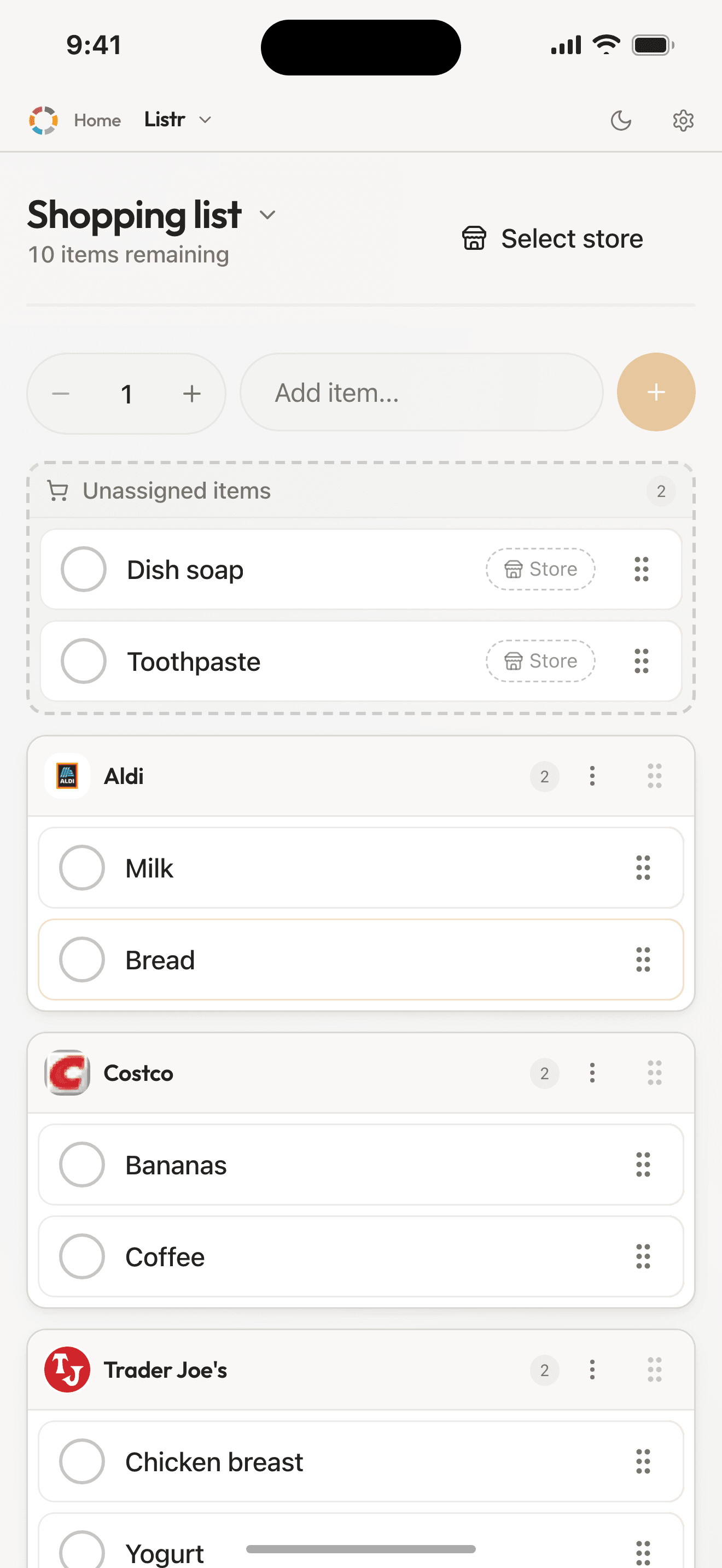
Listr keeps one shopping list anyone can add to, including whoever is already in the store
Dinner without stressOrganr Plus
From the fridge to the dinner table
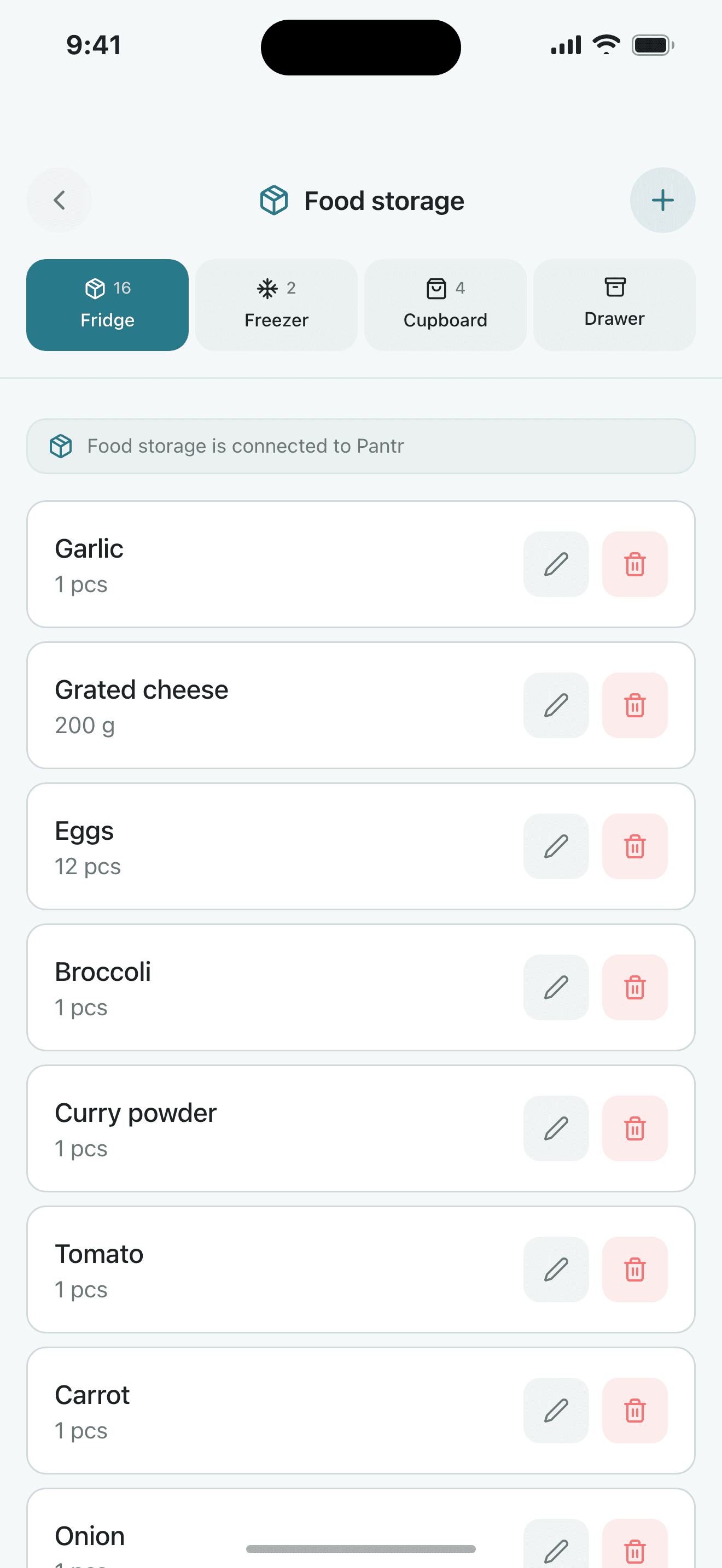
1Pantr knows what is actually at home
2Fridgr suggests dinner from what you already have
3Fridgr walks you through the recipe, step by step
4Listr fills in whatever is missing
Less food wasteOrganr Plus
Use it up before it goes off
1Pantr flags the items that are nearing their use-by date
2Fridgr flags the dinner suggestions that use exactly those
The upgrade
Your shopping list has no idea what is in the cupboard.
Organr makes the week hang together, but it knows nothing about the food. And the food is what costs you most.
Your week already works
You already have Calendr, Taskr and Listr. The week is somewhere everyone can see it, and the shopping list is shared. That part works. The rest of this is about the shopping list itself.
But the list is written from memory
Nobody goes through the fridge, the freezer and the cupboards before filling it in. Whatever sits at the back, nobody remembers. And at five o'clock, someone is already in the shop. Dinner still is not decided.
So you buy it twice and bin the rest
A third tin of tomatoes goes into the cupboard. The mince behind the milk sits there until it has to be thrown out. A household throws away food it already paid for, and a good deal of it was bought twice.
Organr Plus adds three modules about food
Pantr knows what is actually at home, and passes on whatever has run out. Fridgr suggests dinner from what you have, and sends the gaps the same way. Both of them end up in Listr, the list you already open every week. Recipr keeps the recipes you actually cook, so dinner stops having to be invented from scratch.
PantrFridgr
Listryou have this
Recipr
The step from Organr to Organr Plus
Per week
+$2.00
Per month
+$8.00
Per year
+$80.00
The step costs $8.00 a month. If you bin or double-buy five times that much food, saving a fifth of it is enough to pay for the step. A fifth is a cautious estimate. All of Organr Plus is $13.90 a month for six members.
Everything lives in one database in the EU. What travels between your phone and the server is encrypted. The database is set up so one family never gets to see another family's data. Our own family's calendar and shopping list sit in that same database.
A separate PIN for every family member
Encrypted connection
Automatic backup in the cloud
Data tied to your account, not your phone
We don't sell data
Organr is built by a family in Norway who use it themselves, every day. The details are right because we have to live with them.
Yes. Organr is one app with six modules in it: shopping list, calendar, chores, pantry, dinner ideas and recipes. One download, one family account with a PIN for each member.
Do push notifications work on iPhone?
Yes. You add Organr to your home screen from the browser. Then turn notifications on under Settings in the app. They arrive just like a normal app's. Requires iOS 16.4 or later.
Where is data stored?
In the EU. With Supabase, in the eu-central-1 region. Your data belongs to the family account rather than the phone. Change phones and it is all still there. Cancel the subscription and the data stays put; ask us to delete the account and everything is removed within 30 days.
Can we pick the modules ourselves?
No, and that is deliberate. We sell two packages with fixed contents: Organr is the shopping list, calendar and chores. Organr Plus adds the pantry, dinners and recipes. The reason is that the value sits between the modules: when the milk runs out in Pantr, it is one tap from the Listr shopping list. A free pick would break those links.
Don't we have enough apps already?
You do. And that is exactly why Organr is one app and not six. It takes over from the text thread and the sticky notes on the fridge.
We already use Google Calendar, isn't that enough?
Google Calendar is built for meetings. Calendr is built for a home: every person has their own color. Add something that clashes with an appointment already in there, and the app says so.
Can't I just write a shopping list in Notes?
Sure. But in Listr the whole family watches the list change, sorted by store. That is the end of the 'can you add milk?' messages.
Does it cost anything?
7 days completely free. To keep going, it's $5.90/month for Organr or $13.90/month for Organr Plus. Six members are included in both.
How much do we actually save?
It depends on your family. The two biggest items are the food that gets binned and the hours that go on coordinating. The arithmetic is further up this page. Recover a little of either and $13.90 a month pays for itself.
Want to try a week like that?
7 days free with all six modules. Pick a package afterwards, once you know what you actually use.