Why Organr
What does everyday chaos cost?
It is not one big bill, but lots of small ones that nobody ever adds up: the takeaway ordered because it hit five o'clock, the cheese at the back of the fridge that got bought again. Run the numbers on your own week below.
An ordinary week
Nobody has the whole picture. Everybody has a piece of it.
One of you knows when practice starts. Someone else knows what is left in the freezer. At four o'clock on a Thursday, nobody knows both. It rarely turns into one big problem, just a lot of small leaks: a little food in the bin, a few too many messages back and forth before anything is settled. The calculator below takes them one at a time, so you never have to guess at a yearly number.
The math
Answer one question at a time.
Nobody knows what they throw out over a year. Most people have a rough idea what goes in the bin in a week. Start there, and the page works out the rest.
What ends up in the bin most often?
Pick whatever looks most like a normal week in your house. Think dinner leftovers and whatever is sitting at the back of the fridge.
The food-waste levels are grounded in Matvett's figure for a Norwegian family of four. The rest are conservative estimates, so adjust them with your own numbers.
Interplay
This is what a week looks like when it connects.
What follows is not six modules side by side, but three situations you will recognise from your own week.
Calendr + Taskr + Listr
OrganrWho goes where, who does what.
Practice and pickups sit in Calendr, so nobody has to ask. The housework sits in Taskr with points on it, and whoever takes it first gets them. And the shopping list in Listr is the same one for everybody, including whoever is already standing in the store.
Taskr for the whole family
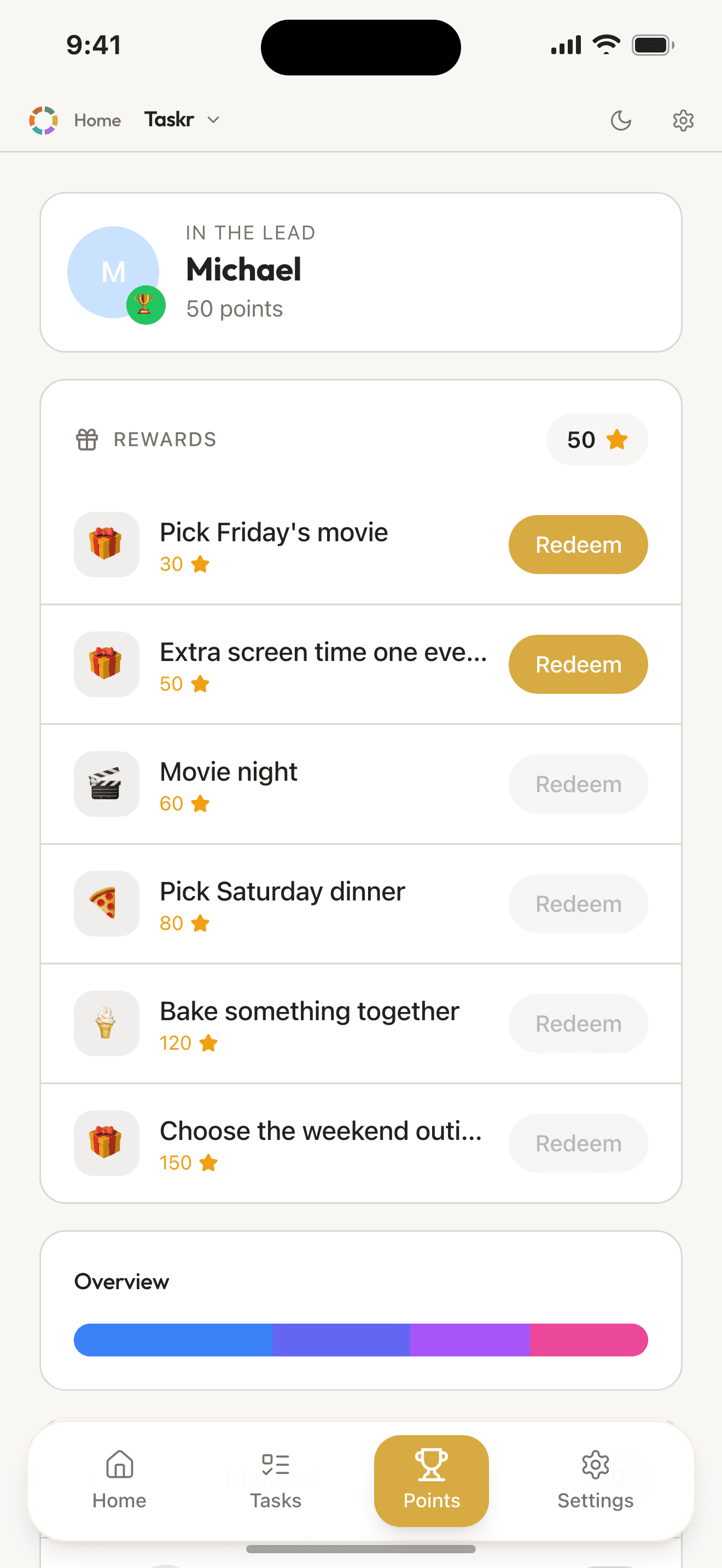
The chores have to be done anyway, so let whoever is first take the points.
- The chores sit open to everyone, adults as well as children
- Whoever does a chore first gets the points for it
- The points build toward a prize you set yourselves, each on your own or as a team
The point isn't six modules. The point is that nobody in the house has to be the one who remembers everything for everyone else.
Seven days free
Try it on your own week.
The math above is an estimate. The only measurement that counts is the one you take yourselves.